A mold inspection is a professional assessment of a property that checks for mold growth, locates the moisture behind it, and determines how extensive the problem is. A trained inspector combines a visual walkthrough with moisture mapping and thermal imaging, and adds air or surface sampling only when the findings warrant it, then documents everything in a written report. It matters because mold growth signals an underlying moisture problem that typically needs to be fixed, and because a documented inspection can support a remediation plan, a real estate transaction, or an insurance claim. Here’s what’s actually included, how the process works, what it costs in New Jersey, and where it’s available.
What Does a Mold Inspection Include?
A thorough mold inspection generally combines several steps, not just a quick look around:
- Visual inspection. A trained inspector checks visible surfaces for growth, staining, and water damage.
- Moisture mapping. A moisture meter identifies damp materials, including ones that haven’t produced visible mold yet.
- Thermal imaging. An infrared camera can reveal temperature differences that suggest hidden moisture behind walls or ceilings.
- Air quality testing. When warranted, air samples are collected and sent to an accredited third-party lab.
- Surface testing. A swab or tape-lift sample can test a specific suspect area directly.
- A written report. Documented findings and recommendations you can act on or share with a contractor, agent, or insurer.
Most inspections take roughly one to two hours on-site, depending on the size of the property and how many areas need a closer look.
Why Is a Mold Inspection Important?
Mold inspection matters because mold growth is a symptom of an underlying moisture problem, and because the health effects, while usually not severe, are real enough to take seriously. The EPA notes that mold “can appear in a wide range of colors” and can cause allergic reactions and irritate the eyes, skin, nose, throat, and lungs. People with asthma, chronic respiratory conditions, weakened immune systems, or who are very young or elderly may be more sensitive to exposure. An inspection doesn’t diagnose a medical condition on its own, but a documented assessment gives you (and, where needed, a doctor, contractor, or insurer) a clear, specific picture of what’s happening rather than a guess. For buyers and sellers, mold disclosure is often required in a real estate transaction, and while a mold finding rarely stops a sale outright, it commonly gives a buyer the opening to negotiate repairs or a price adjustment before closing.
Mold Inspection vs. Mold Testing: What’s the Difference?
They’re related but not identical, and mixing them up is one of the most common points of confusion for first-time searchers. A mold inspection is the visual and diagnostic assessment described above — looking for growth, mapping moisture, and checking for hidden problem areas. Mold testing specifically means collecting air or surface samples and sending them to a lab to identify what’s present. The CDC is direct about when testing is actually necessary: “CDC does not recommend mold testing,” and “you do not need to know the type of mold” to know what to do about it, because “if mold is growing in your home, you need to clean up the mold and fix the moisture problem” regardless of species. In practice, that means a visual inspection and moisture assessment is often sufficient to confirm a problem and plan next steps — sampling becomes useful mainly for documentation purposes (a sale, a dispute, a lingering health concern) or to pinpoint a hidden source that visual and moisture checks alone can’t locate.
How Does the Mold Inspection Process Work?
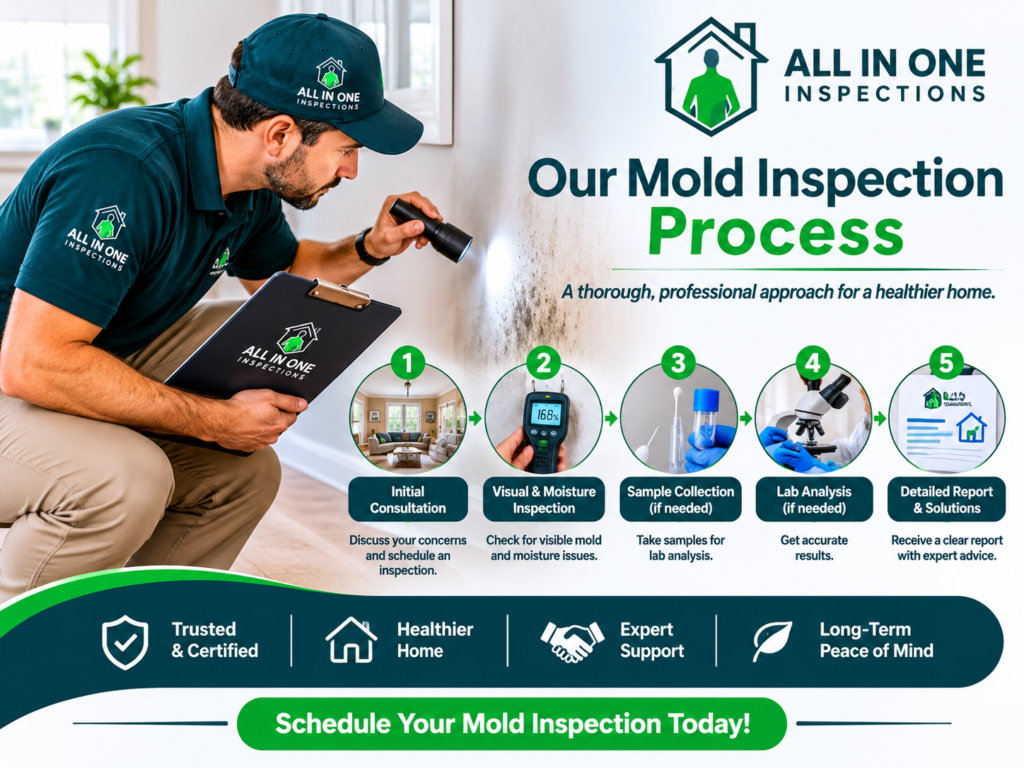
Here’s what a typical visit actually looks like, step by step:
The Mold Inspection Process
| Step | What Happens |
| 1. Initial Consultation | You describe what you’re seeing or smelling, and when it started. This helps the inspector anticipate likely problem areas before arriving. |
| 2. Visual Inspection | The inspector walks the property looking for visible growth, staining, discoloration, and signs of past or active water damage. |
| 3. Moisture Mapping | A moisture meter checks walls, floors, and other materials to find damp areas that aren’t visible yet, including ones that haven’t produced visible mold. |
| 4. Thermal Imaging | An infrared camera can reveal temperature differences that often point to hidden moisture behind walls, ceilings, or flooring. |
| 5. Air & Surface Testing | When visual and moisture findings warrant it, air or surface (swab/tape-lift) samples are collected and sent to an accredited third-party lab — this step isn’t automatic for every inspection. |
| 6. Written Report | You receive documented findings and recommendations — useful for planning remediation, a real estate transaction, or an insurance claim. |
All In One Inspections follows this same process for every Professional Mold Inspection NJ visit, backed by more than 7 years of experience serving Ocean, Union, Mercer, Monmouth, Somerset, Middlesex, and Burlington counties.
How Much Does a Mold Inspection Cost in New Jersey?
Cost depends heavily on whether sampling is involved and how many samples are taken. Based on current NJ-focused industry pricing data (not All In One Inspections’ own published rate, since the service doesn’t list a flat fee on its site), typical ranges look like this:
Typical NJ Mold Inspection Costs
| Service | Typical Cost | Notes |
| Visual inspection only (no sampling) | $150 – $500 | A walkthrough, moisture check, and visual assessment without lab testing |
| Full inspection + sampling + lab analysis | $300 – $1,000 | Visual inspection plus air and/or surface samples sent to an accredited lab |
| Air sample lab fee (per sample) | ~$250 – $350 | Often the single biggest line item; cost scales with the number of samples taken |
| Surface/swab sample | $200 – $300 | Tests a specific suspect area directly, such as a stain or discolored patch |
| Additional sample (beyond the first) | $75 – $150 each | Extra samples are often needed to compare an affected area against a clean baseline area |
| Post-remediation clearance test | $100 – $300 | Confirms remediation worked before a space is considered clear |
A few factors move the price up or down: how many samples are taken (the single biggest line-item driver), the size of the home and number of problem areas, whether hard-to-reach locations like a basement, attic, or HVAC system need testing, whether suspected black mold adds containment or PPE costs, and how fast you need lab results back (rush turnaround typically adds a per-sample fee). These figures are drawn from current market pricing data for New Jersey rather than a guaranteed quote — the only way to get an exact number for your property is to call and describe your situation.
Is Emergency Mold Inspection Available?
Availability depends on scheduling. All In One Inspections’ standard appointments run Monday through Friday, 9am to 5pm, so if your situation is urgent, active water damage, a sudden musty smell throughout a room, or a closing deadline, the most reliable way to find out how quickly you can be seen is to call 908-910-8203 and explain what’s going on, rather than assuming a guaranteed same-day or 24/7 slot.
Where Is Professional Mold Inspection Available in New Jersey?
All In One Inspections is based in Shrewsbury and serves Monmouth, Ocean, Union, Mercer, Somerset, Middlesex, and Burlington counties. Here’s how that maps to a few specific towns people often search for:
Where We Serve
| Town | County | Note |
| Shrewsbury | Monmouth County | All In One Inspections’ home base — scheduling here is typically the most flexible |
| Red Bank | Monmouth County | A few miles from Shrewsbury; regularly served |
| Toms River | Ocean County | Ocean County’s seat; within AIO’s confirmed service area |
| Edison | Middlesex County | Explicitly listed among the communities AIO serves |
| Princeton | Mercer County | Mercer County is one of AIO’s seven confirmed service counties |
If your town isn’t listed here, it may still fall within one of the seven counties above — the quickest way to confirm is to call directly.
Who Should Get a Mold Inspection?
- Home buyers and sellers who want documentation before closing, or to address a concern raised during a walkthrough.
- Anyone with recent water damage, a leak, flooding, or a sewage backup, where mold growth is a real possibility even if nothing is visible yet.
- Anyone noticing a persistent musty smell without an obvious visible source.
- Households with allergy, asthma, or respiratory symptoms that seem tied to being in a specific space.
- Anyone who just completed remediation and wants a clearance test confirming the work was effective.
Common Misconceptions About Mold Inspections
Assuming every inspection requires lab sampling. A visual and moisture assessment alone is often enough to confirm a problem and plan next steps — sampling is a separate, optional add-on, not a mandatory part of every visit.
Assuming no visible mold means no problem. Hidden moisture behind walls or under flooring can exist well before mold becomes visible, which is exactly why moisture mapping and thermal imaging are part of the process.
Assuming a home test kit is a substitute for a professional inspection. A kit can’t map moisture sources or check hard-to-reach areas, and it won’t produce the kind of documented report a sale, claim, or contractor typically needs.
Frequently Asked Questions
How long does a mold inspection take?
Most inspections take roughly one to two hours on-site, depending on the size of the property and how many areas need a closer look.
Do I need a mold inspection before buying a house?
It’s not legally required in most cases, but it’s a common step for buyers who want documentation of a property’s condition, especially in older homes or ones with a history of water damage.
Is mold inspection the same as mold testing?
No. An inspection is a visual and moisture assessment; testing specifically means lab sampling, which CDC does not consider necessary before removing visible mold.
Is emergency mold inspection available in NJ?
Availability depends on current scheduling. Call directly and describe your situation rather than assuming a guaranteed same-day or 24/7 appointment.
How much does a mold inspection cost in New Jersey?
Visual-only inspections typically run 150–500; full inspections with sampling and lab analysis typically run 300–1,000, depending mainly on how many samples are needed.
Ready to Schedule Your Professional Mold Inspection in NJ?
A mold inspection is a documented, professional way to find out whether mold is present, how extensive it is, and what’s causing it — without automatically requiring lab testing to get useful answers. It matters because the moisture behind mold growth usually needs fixing regardless of species, and because documented findings support remediation planning, real estate transactions, and insurance claims. If you’re in Shrewsbury, Red Bank, Toms River, Edison, Princeton, or anywhere in Monmouth, Ocean, Union, Mercer, Somerset, Middlesex, or Burlington counties, request a Professional Mold Inspection NJ from All In One Inspections, or call 908-910-8203 to talk through your specific situation.