By the certified team at All In One Inspections — serving Holmdel & central New Jersey
Black mold and regular mold differ mainly in species, appearance, and health risk. Black mold — usually Stachybotrys chartarum — is a dark greenish-black, often slimy mold tied to long-term moisture and greater health concern, while “regular” mold refers to the dozens of common, usually less harmful household molds that appear in many colors. The honest truth, though, is that you cannot reliably tell them apart by sight alone; professional lab testing is the only way to know for certain.
At All In One Inspections, we’ve spent more than seven years helping homeowners across Holmdel and Monmouth County answer one nervous question: “Is this black mold, and should I be worried?” In this guide, our certified inspectors explain how to identify black mold, what it looks like, how it compares to other household molds, what testing involves, and exactly when it’s time to call a professional for black mold testing in Holmdel.
Quick Answer: Black Mold vs. Regular Mold at a Glance
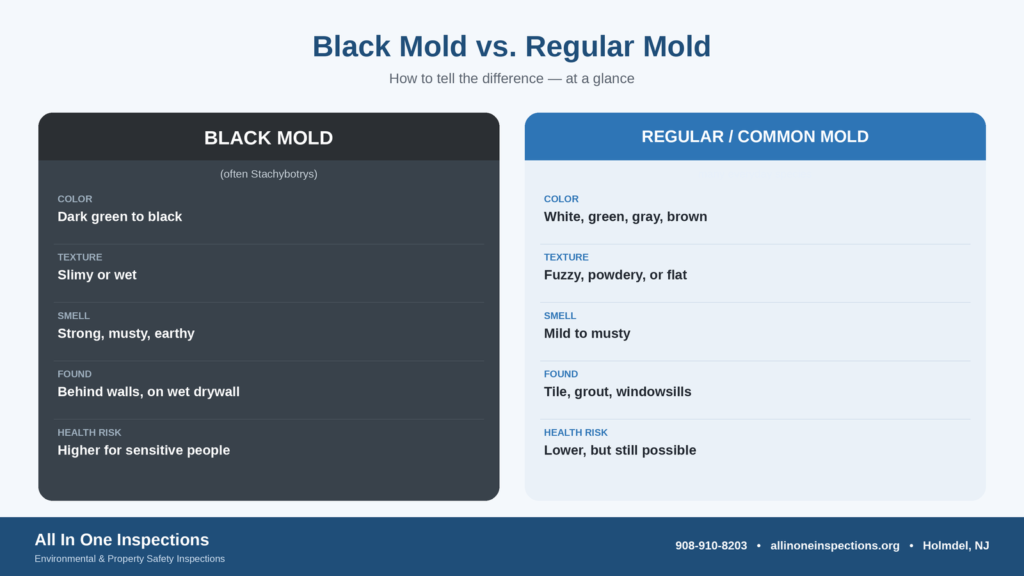
Here’s a fast comparison of black mold vs. regular mold. Use it as a starting point — but remember that toxic mold vs. regular mold can only be confirmed with sampling and lab analysis.
| Factor | Black Mold (Stachybotrys) | Regular / Common Mold |
| Color | Dark green to black | White, green, gray, brown, orange |
| Texture | Slimy or wet; sometimes powdery | Fuzzy, powdery, or flat |
| Smell | Strong, musty, earthy | Mild to musty |
| Typical spot | Chronic moisture: drywall, wood, behind walls | Damp tile, grout, windowsills, food |
| Health risk | Higher for sensitive individuals | Lower, but still possible |
What Is Mold, and Why Do Holmdel Homes Get It?
Mold is a microscopic fungus that grows wherever there is moisture, organic material (like drywall or wood), and time. Spores are always floating in the air; they only become a problem when they land on a damp surface and start to colonize. That’s why nearly every mold issue we find in Holmdel traces back to a water source — a leak, flooding, condensation, or simple high humidity.
Local Conditions That Make Holmdel & Monmouth County Mold-Prone
Holmdel sits in a part of New Jersey that practically invites mold. Our humid, coastal-influenced summers keep indoor moisture high, while Nor’easters and heavy seasonal rain push water into basements and crawl spaces. Add in the area’s many older homes — with finished basements, original windows, and aging foundations — and you have ideal conditions for mold growth. After a major storm, mold can begin colonizing damp materials in as little as 24 to 48 hours.
| Professional insightIn our experience across Monmouth County, the most common hidden mold sources are finished basements after foundation seepage, bathrooms with poor ventilation, and the area around aging HVAC systems. If your home has any of these, it’s worth knowing the warning signs. |
What Does Black Mold Look Like?
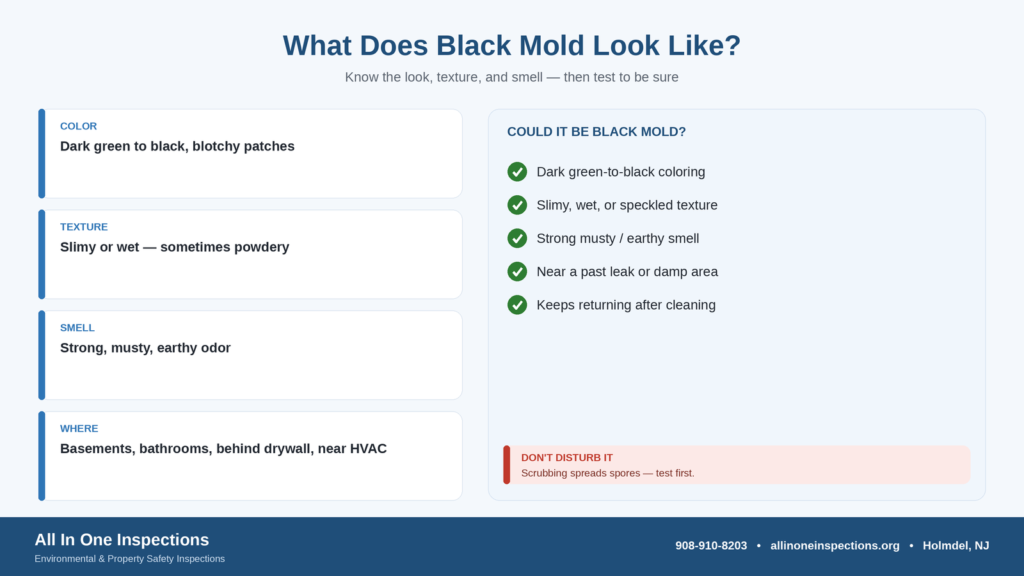
So, what does black mold look like? Black mold typically appears as dark green-to-black clustered spots or patches with a slimy or wet sheen, though it can look powdery as it dries. It often spreads in a circular or blotchy pattern and gives off a strong, musty, earthy odor. In Holmdel homes, we most often find it in basements, bathrooms, behind drywall, under sinks, around windows, and near HVAC systems — anywhere moisture lingers.
Black Mold Identification: Color, Texture, and Smell
For quick black mold identification, run through this checklist. If several of these are true, treat it as suspected black mold and avoid disturbing it:
• Dark green-to-black coloring
• Slimy, wet, or speckled texture
• Strong musty or earthy smell
• Located near a past leak or ongoing moisture
• Keeps coming back after you clean it
| ⚠️ Safety warning: Never scrub, scrape, or disturb suspected black mold yourself. Disturbing it releases spores into the air and can spread the problem throughout your home. Test first, then remediate. This is the single most common mistake we see Holmdel homeowners make. |
Common Types of Household Mold (and How to Identify Them)
“Black mold” gets the headlines, but there are many types of household mold. Knowing the common types of mold in homes helps you understand what you might be dealing with — while remembering that visual ID alone is never conclusive.
• Stachybotrys chartarum (“black mold”): dark green/black, slimy; grows on chronically wet drywall and wood.
• Cladosporium: green, brown, or black; common on damp fabrics, tile, and grout.
• Aspergillus: gray-green and very common indoors; can affect those with allergies or weak immune systems.
• Penicillium: blue-green and fast-spreading after water damage.
• Alternaria: dark and velvety; loves damp bathrooms and under leaky sinks.
Many of these look alike, which is exactly why guessing is risky — and why accurate mold identification in Holmdel relies on lab analysis, not the naked eye.
Mold Color Meaning: White vs. Green vs. Black
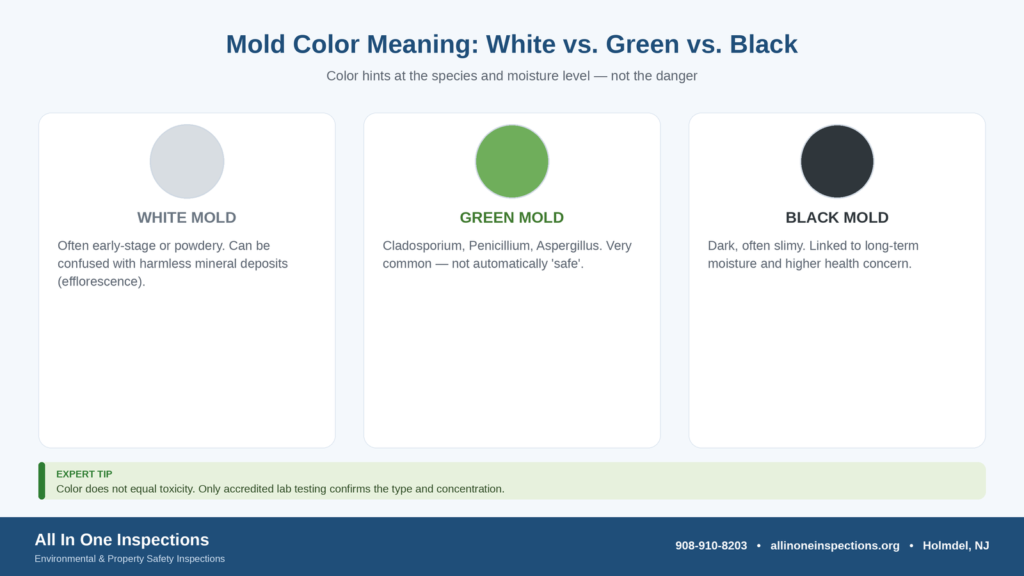
People often ask about mold color meaning — does color tell you how dangerous mold is? Color hints at the likely species and moisture level, but it does not, by itself, determine toxicity.
White Mold vs. Black Mold
In the white mold vs. black mold question, white mold is often early-stage growth or a different species; it’s typically powdery and can be confused with efflorescence (harmless mineral salt deposits on masonry). Black mold is darker, often slimy, and usually signals a longer-standing moisture problem.
Green Mold vs. Black Mold
For green mold vs. black mold, green molds like Cladosporium, Penicillium, and Aspergillus are extremely common and not necessarily “safer” than black mold. The bottom line: never assume a green or white patch is harmless just because it isn’t black.
Is It Black Mold or Mildew?
Homeowners frequently wonder, “is it black mold or mildew?” Mildew is a surface-level fungus — usually flat, gray or white, and easy to wipe off tile or grout. Mold, including black mold, penetrates deeper into materials, often has a raised or fuzzy/slimy texture, and returns after cleaning. If the growth keeps coming back or sits on drywall, wood, or behind a wall, it’s more likely mold than mildew — and worth testing.
How to Tell If Mold Is Toxic
Wondering how to tell if mold is toxic? The term “toxic mold” refers to molds that can produce mycotoxins under certain conditions. You can’t confirm toxicity by looking — but these factors raise the concern level and point toward dangerous mold types:
• The affected area is larger than about 10 square feet
• Growth keeps returning despite cleaning
• There’s a history of water damage, flooding, or leaks
• Household members have unexplained respiratory or allergy symptoms
Is Black Mold Worse Than Regular Mold?
Is black mold worse than regular mold? For sensitive individuals — children, older adults, and anyone with asthma or a weakened immune system — black mold is associated with higher health risk. That said, any indoor mold paired with moisture should be addressed. What does toxic black mold look like in real life? Often the same dark, slimy patches described above — which is precisely why testing, not appearance, is the deciding factor.
How Do I Know If I Have Black Mold? Warning Signs
If you’re asking “how do I know if I have black mold,” watch for these warning signs in your home and your health:
Signs in your home
• A persistent musty odor, even when nothing is visible
• Dark spots or staining on walls, ceilings, or grout
• Past or ongoing leaks, flooding, or high humidity
• Peeling paint, warped walls, or visible condensation
Signs in your health
• Coughing, sneezing, or congestion that improves when you leave the house
• Itchy eyes or throat irritation indoors
• Worsening asthma or allergy symptoms at home
| ⚠️ Worth acting onIf family members feel noticeably better away from home, treat it as a strong signal to schedule professional mold testing in Holmdel. |
When Should I Worry About Mold?
When should I worry about mold? Use this simple framework:
1. Small and surface-level (under ~10 sq ft, on hard surfaces): you may be able to clean it — but find and fix the moisture source first.
2. Large, recurring, or on porous materials (drywall, wood, insulation): stop and call a professional for testing before disturbing it.
3. Vulnerable occupants or health symptoms present: prioritize testing regardless of the visible size.
| Real local exampleA Holmdel homeowner called us after a Nor’easter left recurring black spots in a finished basement. They’d cleaned it twice with bleach, and it kept returning. Our testing confirmed elevated Stachybotrys, and moisture mapping traced the cause to foundation seepage. Fixing the water source — not just wiping the surface — was the real solution. |
Black Mold Testing in Holmdel: What to Expect
Professional black mold testing in Holmdel removes the guesswork. Here’s our step-by-step process:
4. Visual inspection of problem areas and moisture-prone spots.
5. Moisture mapping with meters and, when needed, thermal imaging to find hidden water.
6. Air and surface sampling (swab or tape lift) collected for analysis.
7. Accredited lab analysis to identify the exact mold species and concentration.
8. A clear, photo-documented report — typically within 24 to 48 hours — with practical recommendations.
Emergency Mold Testing Service in Holmdel
After a flood, burst pipe, or with a real estate closing on the line, timing matters. Our emergency mold testing service in Holmdel offers fast, often same-week scheduling so you can act before mold spreads or a deal stalls. If remediation is needed afterward, we’ll guide you on next steps and what to look for when searching “black mold removal near me.”
How Much Does Mold Testing Cost in Holmdel?
Mold testing cost in Holmdel depends on a few factors: the size of your property, how many samples are needed, whether you need air or surface testing (or both), and lab fees. A focused single-area test costs less than a whole-home assessment with multiple samples. While prices vary, testing is almost always far cheaper than dealing with undetected mold damage, failed remediation, or a derailed home sale.
Because every situation is different, we provide transparent, up-front pricing. Call 908-910-8203 for a free, no-obligation quote tailored to your home.
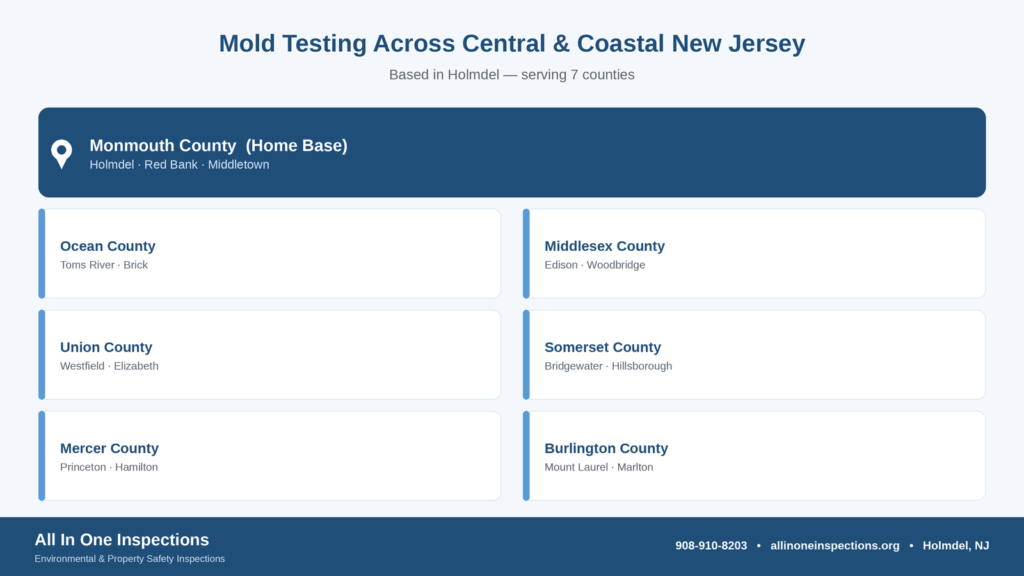
Mold Testing Across Central & Coastal New Jersey
While Holmdel is our home base, All In One Inspections provides mold inspection, identification, and testing throughout central and coastal New Jersey. Local conditions vary by county — and so do the most common mold causes:
• Monmouth County (Holmdel, Red Bank, Middletown): coastal humidity and older finished basements.
• Ocean County (Toms River, Brick): shore flooding and post-storm moisture.
• Middlesex County (Edison, Woodbridge): dense, aging housing stock.
• Union County (Westfield, Elizabeth): older construction with damp basements.
• Somerset County (Bridgewater, Hillsborough): clay soil and basement seepage.
• Mercer County (Princeton, Hamilton): historic homes and high summer humidity.
• Burlington County (Mount Laurel, Marlton): high water tables and damp crawl spaces.
No matter your county, the principle is the same: find the moisture, identify the mold, and fix the source.
How to Prevent Mold in Your Holmdel Home
You can’t eliminate mold spores entirely, but you can control the moisture they need. Follow these prevention and maintenance tips:
• Keep indoor humidity below 50% — a dehumidifier is essential in many Holmdel basements
• Fix leaks and water intrusion fast, ideally within 24–48 hours
• Ventilate bathrooms, kitchens, and attics properly
• Direct gutters and grade soil away from your foundation
• Inspect after every major storm, especially near the shore
• Schedule periodic professional inspections for older homes
When to Call a Professional in Holmdel
Call a professional for mold testing in Holmdel when any of the following apply:
• You see visible mold covering more than about 10 square feet
• Mold keeps returning after you clean it
• Your home recently flooded or had a significant leak
• You’re buying or selling a home and need documented results
• Household members have unexplained respiratory or allergy symptoms
• You simply can’t tell what kind of mold it is — and want certainty
A professional removes the guesswork with lab-backed results, protects your family’s health, and safeguards your property’s value.
Why Choose Us for Mold Testing in Holmdel
As one of the most trusted names for mold testing in Holmdel, All In One Inspections combines local expertise with rigorous, lab-backed results. Here’s why homeowners, buyers, and property managers choose us:
• Over 7 years of experience and certified, knowledgeable inspectors
• Fully licensed and insured, with accredited lab partners
• Clear, photo-documented reports — usually within 24–48 hours
• Deep familiarity with Holmdel and Monmouth County homes, soil, and storm patterns
• Honest recommendations — we’ll tell you when you don’t need remediation
• Fast, responsive service, including emergency mold testing
Our clients consistently describe our work as thorough, professional, and reassuring — because we explain every finding in plain language and put your health and peace of mind first.
Worried It Might Be Black Mold? Don’t Guess — Get Answers
You can’t reliably tell black mold from regular mold by sight, so when in doubt, test. If you’ve spotted suspicious growth, smelled a persistent musty odor, or had recent water damage, get accurate, lab-backed answers fast.
👉 Schedule your professional mold testing today. Visit our Mold Testing service page or call All In One Inspections at 908-910-8203 for a free, no-obligation quote. Serving Holmdel and all of central and coastal New Jersey.
Local FAQs
Q1. How do I know if I have black mold in my Holmdel home?
Look for dark, slimy patches with a strong musty smell near past leaks, then confirm with professional black mold testing, since color alone isn’t reliable.
Q2. Is black mold worse than regular mold?
Black mold carries higher health risk for sensitive individuals, but any indoor mold combined with moisture should be addressed promptly.
Q3. Is it black mold or just mildew?
Mildew is flat, surface-level, and wipes away easily, while black mold penetrates materials, often looks slimy, and keeps returning after cleaning.
Q4. How much does black mold testing cost in Holmdel?
Costs vary by property size and number of samples, so call 908-910-8203 for a free, no-obligation quote — testing is far cheaper than undetected damage.
Q5. Can I test for black mold myself?
DIY kits are often unreliable and can spread spores, so professional sampling with accredited lab analysis gives you accurate, documented results.
Q6. How fast can I get emergency mold testing in Holmdel?
All In One Inspections offers fast, often same-week emergency mold testing with reports typically delivered within 24–48 hours.
Q7. What areas do you serve besides Holmdel?
We provide mold testing across Monmouth, Ocean, Middlesex, Union, Somerset, Mercer, and Burlington counties in New Jersey.