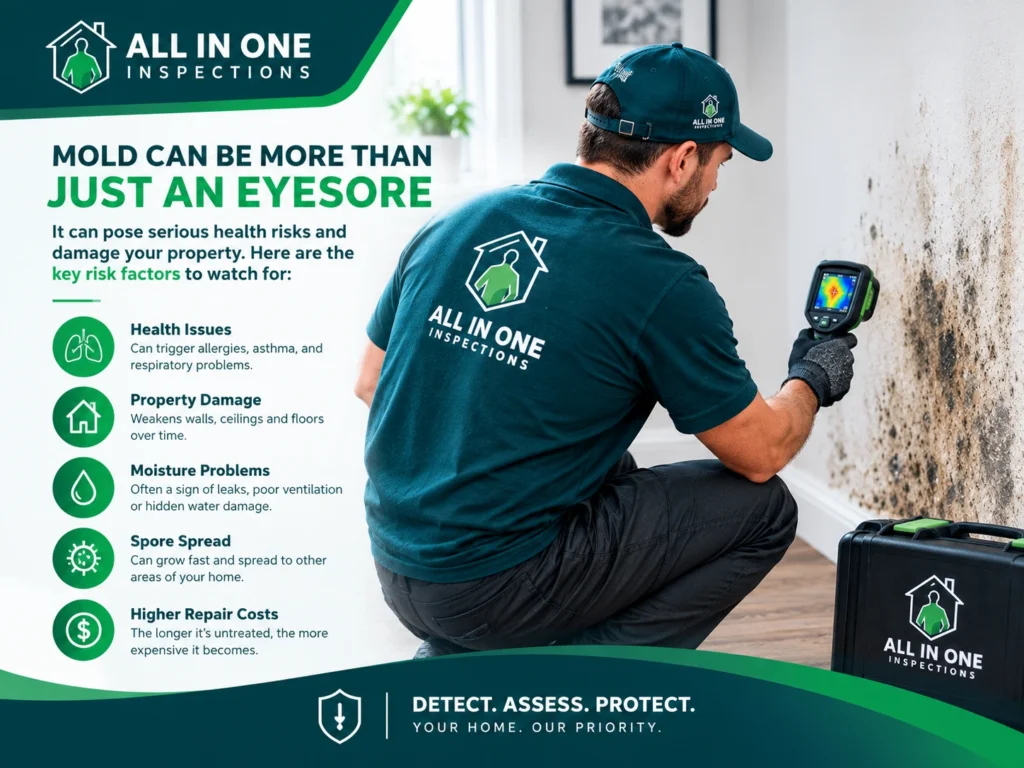
No — a mold being dark or black in color doesn’t automatically make it more dangerous than any other mold growing in a home. The CDC puts it plainly: “All molds should be treated the same with respect to potential health risks and removal.” That single fact changes how you should think about the spot you just found. What actually matters isn’t what color it is, it’s how much of it there is, where it’s growing, how long the area has been wet, and who lives in the home. Here’s what separates a spot you can likely handle yourself from a situation that genuinely calls for a professional inspector in Shrewsbury, NJ.
Is Black Mold Actually More Dangerous Than Other Mold?
No, not based on color alone. The EPA states that mold “can appear in a wide range of colors” and still cause the same allergic or irritant effects, and the CDC is direct about this: “You do not need to know the type of mold” to know what to do about it. Even the species most associated with “toxic black mold,” Stachybotrys chartarum, doesn’t get special treatment in CDC’s own guidance. Its page on that specific mold states, “All molds should be treated the same with respect to potential health risks and removal.” Color can suggest how long an area has been wet or what it’s growing on, but it isn’t a reliable danger signal on its own, and several common indoor molds, including species most people have never heard of, can appear dark or black-ish, which makes visual identification an unreliable way to assess risk in the first place.
What Is “Black Mold,” Really?
“Black mold” isn’t an official medical or scientific category. In casual use, it almost always refers to Stachybotrys chartarum, which CDC describes as “a greenish-black mold.” It grows on cellulose-rich materials, drywall, fiberboard, paper, and similar surfaces, and it needs ongoing dampness from a leak, condensation, or flooding to take hold. “Toxic black mold” is a popular media label, not a term CDC uses to set this species apart from other indoor molds. The other common indoor molds CDC names, Cladosporium, Penicillium, and Aspergillus, aren’t ranked by danger either; CDC doesn’t present one as inherently safer or riskier than another.
What Actually Determines Whether Mold Is Dangerous?
If color isn’t the deciding factor, what is? Based on EPA and CDC guidance, the real risk picture comes down to a handful of practical factors, not the species or its color.
What Actually Drives Mold Risk
| Factor | Why It Matters | When It Applies |
| Moisture source | Ongoing or repeated dampness (a leak, condensation, flooding) is what let the mold grow in the first place, and it’s what needs fixing, per EPA. | Every case |
| Extent and location | A small visible spot is a different situation than hidden growth behind walls, under flooring, or spread across a large area. | Every case |
| Material affected | Porous materials that stayed wet (saturated drywall, carpet padding) may need removal, not just surface cleaning. | Water damage cases |
| How long it’s been wet | Materials wet for 48+ hours are more likely to need professional attention; repeated growth in the same spot signals an unresolved moisture problem. | Recurring cases |
| Who’s exposed | Infants, older adults, and people with asthma, chronic lung disease, or weakened immune systems may react more severely to any mold. | Every case |
This is also why CDC’s advice doesn’t hinge on identifying the mold first: “If mold is growing in your home, you need to clean up the mold and fix the moisture problem.” The moisture problem is the actual root cause in every case, regardless of what’s growing on top of it.
Can You Just Clean It Yourself?
Often, yes, for a small, visible spot. The EPA’s own guidance gives a rough size threshold: if the moldy area is less than about 10 square feet, roughly a 3 ft. by 3 ft. patch, a homeowner can usually handle the cleanup themselves, provided they follow proper cleanup guidelines. CDC’s position lines up with this: it doesn’t recommend testing before cleanup, since “no matter what type of mold is present, you need to remove it” and fix the moisture source behind it. That’s a meaningful, practical answer for a lot of small household spots: a little mold on a shower tile grout line or a windowsill usually doesn’t need a professional visit or a lab test to resolve.
Signs You Should Call a Professional Mold Inspector
The EPA is just as direct about when the DIY approach stops being the right call. Based on its own guidance, a few situations clearly point toward bringing in a professional rather than handling it yourself:
- The area is larger than roughly 10 square feet, or there’s been significant water damage. EPA points directly to its more detailed Mold Remediation in Schools and Commercial Buildings guidance once a problem crosses this size.
- You suspect hidden mold behind walls, under flooring, or in the HVAC system. Disturbing materials like wallpaper or drywall can release large numbers of spores, and EPA specifically advises against running an HVAC system you suspect is contaminated.
- The water source was contaminated, such as sewage backup or flood water. EPA recommends a professional experienced with contaminated-water damage in these cases.
- The mold keeps coming back in the same spot, which usually signals a moisture problem that hasn’t actually been fixed, not a cleaning problem.
- Someone in the home is especially vulnerable, an infant, an older adult, or someone with asthma, chronic lung disease, or a weakened immune system, where EPA suggests consulting a health professional before starting cleanup at all.
- You need documentation, for a real estate transaction, an insurance claim, or a landlord dispute, where a written, professional report carries more weight than a homeowner’s own assessment.
For anyone in Shrewsbury or the surrounding counties who recognizes their situation in that list, All In One Inspections offers a black mold inspection service that covers visual inspection, moisture mapping, thermal imaging, and air or surface sampling when it’s actually warranted, backed by more than 7 years of experience serving Ocean, Union, Mercer, Monmouth, Somerset, Middlesex, and Burlington counties.
Regular Mold Inspection vs. Emergency Mold Inspection
These aren’t two different services so much as two different timelines for the same core process.
Standard vs. Urgent Situations
| Situation | When It Fits | Scheduling | What Happens |
| Standard Mold Inspection | A visible spot, a musty smell, or a routine check (e.g., before buying a home) | Scheduled during regular business hours | Visual inspection, moisture mapping, thermal imaging, and sampling if warranted |
| Emergency / Priority Mold Situation | Active water damage, flooding, a sewage backup, or sudden extensive growth | Call directly to discuss how quickly you can be seen | Same core process, prioritized ahead of the standard queue where possible |
If your situation is genuinely urgent, active water damage, visible mold spreading quickly, or a closing deadline, the most reliable way to find out how fast you can be seen is to call directly and explain what’s going on. All In One Inspections’ standard appointments run Monday through Friday, 9am to 5pm; if your situation falls outside that window, say so when you call rather than assuming a specific guaranteed timeframe.
Common Mistakes People Make About Black Mold
Assuming dark color automatically means danger. This leads to unnecessary panic, and sometimes to paying for more extensive remediation than the actual situation calls for, over a small, manageable spot.
Assuming a lack of black color means it’s safe. Several common indoor molds, none of them “black mold,” can still produce allergic or irritant symptoms. A real moisture problem doesn’t become less real because the mold looks less alarming.
Relying on a home test kit to settle the question. CDC doesn’t recommend mold testing as a decision-making step: “You cannot rely on sampling and culturing to know whether someone might become sick.” The money is usually better spent fixing the moisture source.
Treating every spot the same regardless of size or location. A small, visible patch and hidden growth behind a wall after a flood are not the same problem, and EPA’s own guidance treats them differently for good reason.
Frequently Asked Questions
Does CDC recommend testing to find out what type of mold I have?
No. CDC states plainly, “CDC does not recommend mold testing,” and “you do not need to know the type of mold.” Its guidance focuses on removing visible mold and fixing the moisture source instead.
Is Stachybotrys chartarum (“black mold”) the same as “toxic mold”?
“Toxic black mold” is a popular label, not an official CDC classification. CDC describes Stachybotrys chartarum as a greenish-black mold and states that all molds, this one included, should be treated the same with respect to health risk and removal.
How much mold is too much to clean up myself?
EPA’s rough guideline is about 10 square feet, roughly a 3 ft. by 3 ft. patch. Beyond that, or with significant water damage, EPA recommends bringing in a professional.
What’s the difference between a regular and an emergency mold inspection?
The process is largely the same; what changes is urgency. A regular inspection fits a visible spot or a routine check, scheduled during normal business hours. An urgent situation, like active water damage, is worth a direct call to discuss how quickly it can be addressed.
Can I get a black mold inspection in Shrewsbury, NJ quickly if needed?
Availability depends on current scheduling. Call directly and explain your situation rather than assuming a guaranteed same-day appointment, especially outside standard Monday–Friday, 9am–5pm hours.
Get a Straight Answer, Not a Scare Tactic
Color isn’t the test that matters. What actually determines whether mold is a real problem is the moisture behind it, how much there is, where it’s hiding, and who’s exposed to it. A small visible spot is often a reasonable DIY job under EPA’s own guidance. Hidden growth, a large affected area, repeated recurrence, or a vulnerable household member are the situations worth a professional opinion. If that’s where you are, request a black mold inspection service from All In One Inspections, based right here in Shrewsbury and serving the surrounding NJ counties, or call 908-910-8203 to talk through your specific situation.