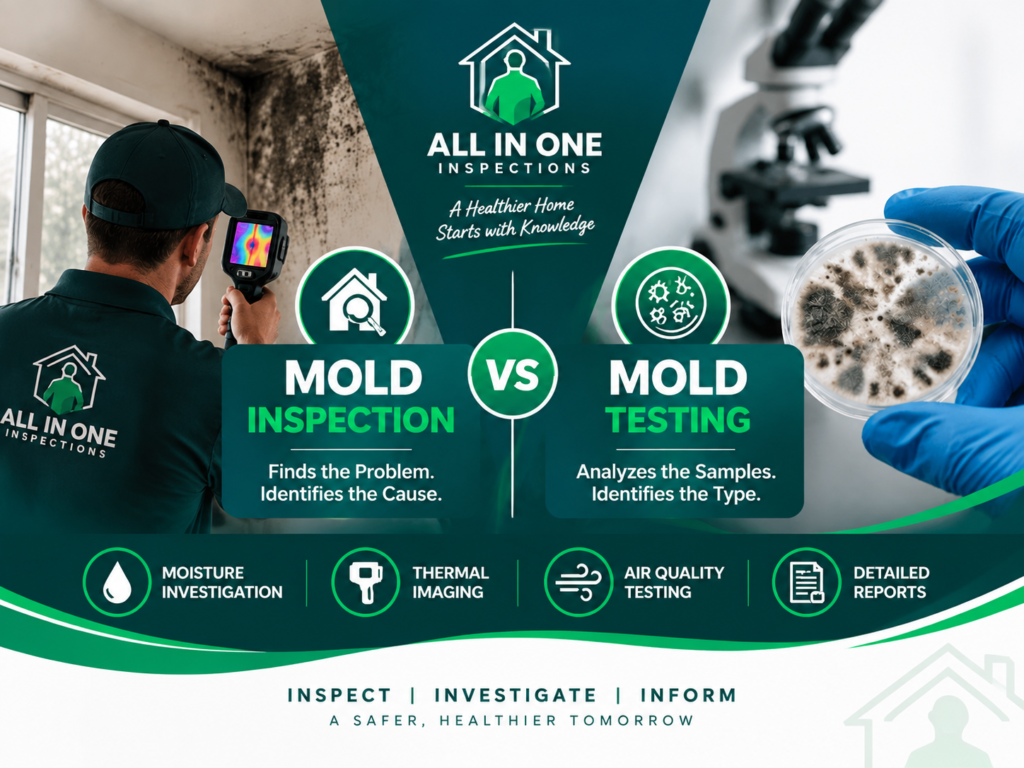
The main difference between mold inspection and mold testing is that a mold inspection evaluates the property to identify possible mold problems, moisture sources, and affected areas, while mold testing involves collecting samples to determine what types of mold particles may be present.
A mold inspection answers:
“Where could mold be growing, why is it happening, and what conditions are contributing to the problem?”
Mold testing answers:
“What type of mold or spores are present in the samples collected?”
In many situations, homeowners do not need only a mold test. They need a proper evaluation of the building conditions causing the concern.
At All In One Inspections, we approach mold concerns as a complete property investigation. Led by Cory Pedalino, with 7+ years of inspection experience and specialized Advanced Mold Inspection Training through InterNACHI, our goal is to help New Jersey homeowners understand not only whether mold may exist but also the moisture conditions that may be contributing to it.
Mold Inspection vs Mold Testing: Quick Comparison
| Mold Inspection | Mold Testing |
| Evaluates the property condition | Analyzes collected samples |
| Searches for visible and hidden moisture concerns | Identifies mold spores/types in samples |
| Looks for possible mold sources | Provides laboratory information |
| Examines building conditions | Examines collected material |
| Helps determine the next step | Supports decision-making when sampling is useful |
The two services are related, but they are not the same.
What Is A Mold Inspection?
A mold inspection is a professional evaluation of a property to identify possible mold growth, moisture problems, and environmental conditions that may support mold development.
A mold inspection typically looks at:
- Visible mold growth
- Musty odors
- Water damage
- Moisture intrusion
- Plumbing leaks
- Basement moisture
- Attic conditions
- Ventilation issues
- Areas where hidden mold may develop
The purpose of a mold inspection is not simply finding mold.
The bigger question is:
Why is mold occurring, and what conditions are allowing it to continue?
What Happens During A Mold Inspection?
A professional mold inspection usually involves several steps.
1. Visual Evaluation
The inspector examines areas where mold concerns commonly occur.
Examples include:
- Basements
- Bathrooms
- Attics
- Crawl spaces
- Around windows
- HVAC areas
- Previous water damage locations
The inspector looks for:
- Discoloration
- Visible growth
- Water stains
- Damage patterns
- Odors
2. Moisture Investigation
Moisture is one of the most important factors connected with mold growth.
A proper inspection may investigate:
- Elevated moisture levels
- Water intrusion
- Plumbing leaks
- Condensation
- Humidity concerns
At All In One Inspections, moisture investigation may include tools such as:
Moisture Mapping
Used to identify areas where moisture may exist behind surfaces or inside building materials.
Thermal Imaging
Infrared technology can help identify temperature differences that may indicate possible moisture-related concerns.
This approach helps move beyond simply identifying visible mold.
3. Inspection Report
After evaluation, homeowners should receive clear findings about:
- Observed conditions
- Areas of concern
- Possible moisture sources
- Recommended next steps
A useful inspection report should help a homeowner understand what action is appropriate.
What Is Mold Testing?
Mold testing is the process of collecting samples from the environment and analyzing them to determine what types of mold spores or particles are present.
Testing may involve:
- Air sampling
- Surface sampling
- Laboratory analysis
The purpose is to provide additional information about the mold conditions in a property.
What Does Mold Testing Detect?
Mold testing can help identify:
- Presence of mold spores in collected samples
- Types of mold detected
- Relative differences between sample locations
However, mold testing alone usually does not answer:
- Where moisture is coming from
- Why mold developed
- How large the affected area is
- Whether building repairs are needed
That is why testing is often most useful when combined with a proper inspection.
Is Mold Inspection The Same As Mold Testing?
No.
A mold inspection and mold testing are different services.
Think about it this way:
Mold Inspection = Investigation
It examines:
- The building
- Moisture conditions
- Possible causes
- Problem areas
Mold Testing = Sampling
It examines:
- Collected samples
- Mold particles
- Laboratory results
A test provides information about samples.
An inspection provides information about the property.
You May Need A Mold Inspection If:
You notice:
- Musty smells
- Water damage
- Moisture problems
- Previous flooding
- Visible staining
- Recurring mold growth
An inspection helps determine the source and extent of the concern.
You May Need Mold Testing If:
You need additional information about:
- Indoor air concerns
- Specific suspected areas
- Documentation
- Unknown mold conditions
Testing is usually more useful when there is a specific question that needs answering.
Do I Need Both Mold Inspection And Testing?
Sometimes yes.
A combined approach can be useful when:
- Mold is suspected but not clearly visible
- A property has experienced water damage
- A buyer wants additional information before purchase
- Indoor environmental concerns exist
The inspection helps determine where to look and what questions need answers.
Testing provides additional information from collected samples.
Which Is Better: Mold Inspection Or Mold Testing?
Neither service is automatically “better.”
They answer different questions.
If your question is:
“Why do I have a mold problem?”
A mold inspection is usually the starting point.
If your question is:
“What mold particles are present in this sample?”
Testing may provide useful information.
For most homeowners, understanding the moisture source and property conditions is the first priority.
Can A Mold Inspection Detect Hidden Mold?
A professional mold inspection can help identify conditions associated with hidden mold.
Examples:
- Moisture behind walls
- Previous water damage
- Hidden leaks
- Damp building materials
However, no inspection method can guarantee detection of every hidden mold area without access to all building materials.
A qualified inspector evaluates risk factors and uses professional methods to identify potential concerns.
Can Mold Testing Detect Hidden Mold?
Mold testing can detect mold particles in collected samples, but it does not automatically locate where mold is growing.
For example:
An air sample may show mold spores are present.
But it may not tell you:
- Where the growth exists
- What caused it
- How much material is affected
That information usually requires a property inspection.
Can You Have Mold Without Seeing It?
Yes.
Mold may exist without obvious visible growth.
Possible warning signs include:
- Persistent musty odors
- Previous water leaks
- Damp areas
- Repeated moisture problems
- Allergy-like symptoms reported by occupants
When mold is suspected but not visible, investigating moisture conditions becomes especially important.
Can Mold Testing Tell Where Mold Is Coming From?
No.
Mold testing can provide information about collected samples, but it generally does not identify the source of the moisture problem.
Finding the cause usually requires investigating:
- Water intrusion
- Leaks
- Humidity
- Ventilation
- Building conditions
Should I Get A Mold Inspection After Water Damage?
Yes, especially if water damage involved:
- Flooding
- Long-term moisture exposure
- Basement water intrusion
- Plumbing leaks
- Roof leaks
Water damage can create conditions where mold may develop.
A professional evaluation can help determine whether further action is needed.
Should I Test For Mold If I Can See It?
Not always.
If visible mold is already present, the priority is usually:
- Identify the moisture source
- Determine the affected area
- Address the underlying problem
Testing may not always change the recommended action.
Why New Jersey Homeowners Choose All In One Inspections
Mold problems are rarely just about mold.
They are often connected with:
- Moisture
- Water intrusion
- Indoor air quality
- Building conditions
This is where All In One Inspections provides a different approach.
Instead of focusing only on a sample result, we evaluate the bigger picture.
Our expertise includes:
✓ 7+ years of inspection experience
✓ Advanced Mold Inspection Training through InterNACHI
✓ Moisture investigation
✓ Thermal imaging technology
✓ Air quality testing
✓ Environmental inspection services
Cory Pedalino’s additional training in areas such as asbestos building inspection, underground storage tanks, and oil tank sweeps supports a broader understanding of property-related environmental concerns.
For homeowners across New Jersey, our goal is simple:
Help you understand your property before making important decisions.
Learn more about our professional mold inspection services in New Jersey.
Frequently Asked Questions
What is the difference between mold inspection and mold testing?
A mold inspection evaluates the property, moisture conditions, and possible mold sources. Mold testing collects samples to analyze mold particles present in those samples.
Is mold inspection necessary?
A mold inspection can be valuable when you have visible mold, moisture issues, water damage, musty odors, or concerns about hidden mold.
Is mold testing necessary?
Mold testing is not required in every situation. It is most useful when sample results will help answer a specific question.
What does a mold inspection look for?
A mold inspection looks for visible mold, moisture problems, water damage, odors, and conditions that may support mold growth.
What does mold testing detect?
Mold testing detects mold particles or spores in collected samples and provides laboratory information about those samples.
How accurate is mold testing?
Accuracy depends on proper sampling methods, sample locations, laboratory procedures, and interpretation of results.
Can a mold inspection find hidden mold?
A professional inspection can identify warning signs and conditions associated with hidden mold, but no inspection can guarantee detection of every hidden area without access.
Final Thoughts: Mold Inspection vs Mold Testing
The difference between mold inspection vs mold testing comes down to one simple idea:
Inspection investigates the property. Testing analyzes samples.
If you are dealing with suspected mold, water damage, or indoor air concerns, starting with the right evaluation can help you avoid unnecessary costs and understand the real problem.
For New Jersey homeowners, All In One Inspections provides a complete approach that combines inspection experience, environmental knowledge, and advanced investigation methods to help you make informed property decisions.